
Insights
Buying land in La Palma: what can be built, restored or developed — and what to check first
Buying rural land on La Palma can be one of the most rewarding transactions in the Canary Islands — and one of the most demanding in terms of due diligence. Whether a plot has genuine potential or is simply photogenic is almost never visible in the listing photographs. It sits in the land classification, in the existing buildings, in the access, in the water and in the paperwork.
Within a few kilometres, La Palma combines elements that appear separately in most markets: protected landscape, working agricultural land, traditional rural architecture, historic scattered settlements, several very different categories of rural land, and an island-specific planning framework that contemplates certain tourism initiatives in the countryside. That combination is precisely what creates the opportunity — and the confusion.
So the first principle is this: on rural land there are no general answers. Every parcel has its own classification, its own constraints and its own history. This article sets out how we read land on La Palma in practice, before a client commits. Binding conclusions come from the relevant town hall and from an independent architect or lawyer — not from an estate agency.
What "suelo rústico" actually means on La Palma
Rural land is not a single category. It is a family of categories with very different consequences: agriculturally protected land, land protected for its landscape or natural values, infrastructure protection, recognised rural settlements (asentamientos rurales), agricultural settlements, and ordinary rural land. Two adjoining plots — same track, same views, same appearance — can fall into different categories and therefore permit entirely different uses.
On La Palma this fragmentation is more pronounced than elsewhere in the archipelago, because topography and agricultural history shaped the settlement pattern. The island grew along fincas and tracks, not along development plans, and a substantial part of island life takes place in scattered settlements that planning recognises as exactly that. In those areas the rules on building and restoration are frequently different from those applying to protected farmland two hundred metres away.
The practical consequence is that price per square metre tells you very little. Value on La Palma comes from classification, constraints and what already stands on the plot. Before valuing anything, establish which category the parcel sits in, which plan governs it, and which protective designations affect it.
Can you build on rural land in La Palma?
The honest answer is: it depends on the classification of the land, on the intended use, on what already exists, and on the applicable municipal and island planning regulations. Any more emphatic answer should raise an eyebrow.
In practice several situations must be kept apart. New-build residential construction on protected rural land is the most restricted case and, in many areas, simply not permitted. Buildings tied to agricultural activity — tool rooms, stores, ancillary structures — follow a different logic, but they are linked to genuine farming activity and to limited dimensions.
The third case, and the most interesting on this island, concerns existing buildings. Restoration, consolidation and limited extension of a pre-existing structure operate under a different regulatory logic from building from scratch — particularly where the structure is old, documented and its use recognised.
The fourth case is tourism. Certain rural accommodation projects can be viable where the planning framework, the land category and sectoral regulation allow it. It is neither automatic nor universal, but it exists, and it is one reason rural land here is assessed differently than in a conventional coastal market.
Finally, some plots carry consolidated, legally recognised residential use. These generate the least uncertainty and — not coincidentally — finance and resell most easily.
Existing buildings change the opportunity entirely
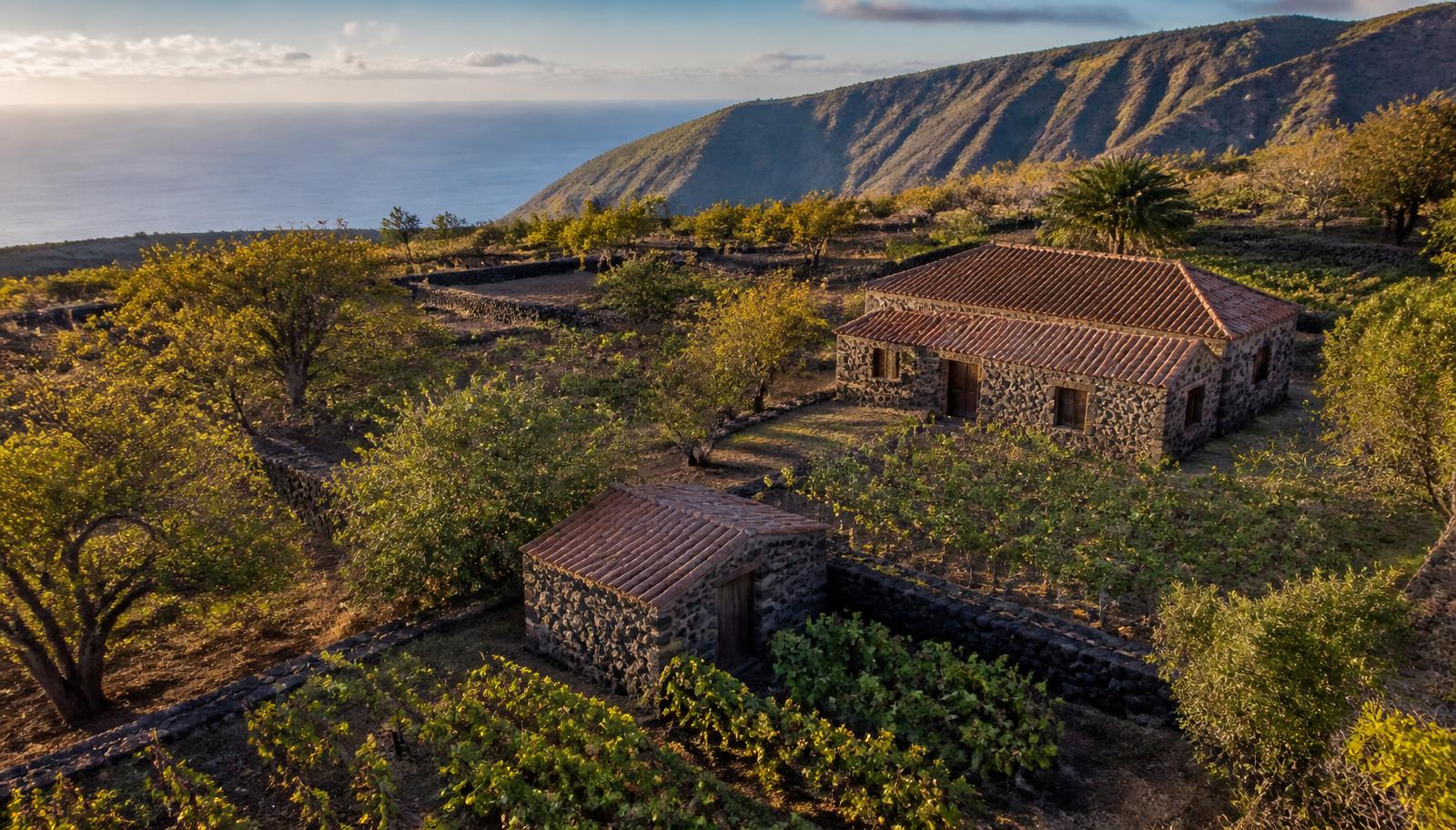
On La Palma, what most often turns an average parcel into an interesting transaction is not its size. It is what already stands on it: pajeros (traditional barn structures), bodegas, cuartos de aperos, old Canarian stone houses, converted caves, threshing floors, water tanks, agricultural stores. Many are decades or centuries old and form part of the island's protected landscape.
A pre-existing building can open the door to interventions that would never be considered on bare land. When we visit a finca, the conversation therefore almost always starts with the structures: what they are, when they were built, their floor area, the use on record, and whether that use is recognised.
What needs investigating is specific: genuine age of construction; cadastral reference and recorded areas; registration and description at the Land Registry; files and licences held by the town hall; the use actually permitted; and, where age matters, historic aerial photography and orthophotos that place the building in time.
And here is the single most important point in this article: a building appearing in Catastro does not mean it is legally authorised as a dwelling. Catastro describes physical reality for administrative and tax purposes; it does not confer planning legality and it does not turn a pajero into a house. International buyers assume the opposite with some regularity — and pay for an expectation that later proves impossible to execute.
Catastro, Land Registry and planning legality: three separate things
CATASTRO — Physical and administrative description of the property, primarily for tax purposes: area, graphic boundaries, estimated year of construction, cadastral use and value. A useful starting point, but no evidence of ownership or of the legality of the works.
REGISTRO DE LA PROPIEDAD (Land Registry) — Legal registration of ownership and of the registered characteristics of the finca, including declarations of new works, charges, easements and restrictions. It establishes who owns the property and what is legally recorded — not what may be built.
PLANNING LEGALITY — This answers the question that actually matters: which uses and which works are permitted on that specific parcel under municipal and island planning and sectoral regulation. It is confirmed at the town hall, through a planning consultation or certificate, ideally with technical support.
Confusing these three layers is by far the most common error among international buyers. "It's in Catastro, so it's legal"; "it's registered, so I can renovate it"; "they pay IBI on the house, so it's a dwelling" — none of these statements stands on its own. The correct approach is to cross-check all three: Catastro for physical reality, the Registry for legal reality, the town hall for planning reality. When the three align, the transaction is solid. When they do not, there is work ahead — and sometimes the right decision is to walk away.
Why La Palma is different: the Green Islands framework
La Palma, together with El Hierro and La Gomera, falls within what is commonly known as the Ley de Islas Verdes — the Green Islands framework: a planning approach for islands of low tourism density, under which certain tourism initiatives can coexist with rural landscape, agriculture and environmental protection rather than concentrating in large resort zones.
That approach is precisely why La Palma resembles neither southern Tenerife nor southern Gran Canaria. The model points towards the small, the dispersed and the integrated: rural tourism, boutique accommodation, agrotourism, vineyard-linked projects, nature retreats, wellness concepts, small-scale hospitality — and, above all, the restoration of traditional buildings that would otherwise be lost.
Precision matters here. This framework does not grant tourism development rights to every rural plot. Whether a project is viable depends on the specific finca, its classification, the applicable municipal and island planning, the project itself and the relevant sectoral approvals. There is no automatic entitlement, and anyone presenting it as such is oversimplifying.
That said, for international investors the implication is usually the opposite of what they assume: on La Palma there is a regulatory context that explicitly contemplates certain tourism activity in the countryside. Many buyers arrive convinced that "nothing can be done" on rural land and dismiss, at first glance, properties that — properly structured and properly verified — had real scope. The opportunity is not in stretching the framework, but in finding the finca that already fits inside it.
Agricultural land as an investment proposition
Much of La Palma's rural land is not empty; it is productive. Vineyards in Fuencaliente, Villa de Mazo and the north; avocado and subtropical fruit across the western midlands; bananas along the coast; almond, chestnut and vine at altitude. An operating enterprise changes how a finca should be evaluated.
With genuine agricultural activity come factors a residential buyer rarely considers: income, water rights actually in use, irrigation infrastructure, ancillary buildings justified by the operation, contracts with bodegas or cooperatives, and a land use that planning recognises as legitimate.
In certain cases — always within what the regulations permit for that specific finca — agriculture, built heritage and tourism activity can be combined in a single asset. Economically and visually the model makes sense on La Palma; it is one of the more robust investment theses on the island, and also the one that demands the most technical verification before capital is committed.
Why cheap land is rarely cheap
Plots are habitually compared on total price or price per square metre. On rural land that comparison misleads. A €30,000 parcel with strict protection, no consolidated vehicular access, no water and no buildings can be materially less attractive than a €100,000 finca with a documented old house, access, water and a classification that permits restoration.
The first is landscape. The second is an asset. The difference lies not in the square metres but in what the regulations allow you to do with them.
Hence the idea that summarises this article: on La Palma you buy planning potential, not simply square metres. Buyers who internalise this stop hunting for the largest plot at the lowest price and start hunting for the plot whose documentation survives scrutiny. It is also why genuinely good land rarely reaches the portals: it is placed beforehand, among those who know how to read it.
Due diligence before buying rural land
This is the minimum verification we recommend before signing any reservation. It does not replace professional advice, but it prevents most of the problems we encounter.
Legal documentation: current nota simple from the Land Registry; verification of ownership and, where an estate is involved, of the inheritance position; charges, mortgages, easements and embargoes; and consistency between what is registered and what is being shown on the ground.
Physical and planning documentation: cadastral reference and certificate; actual area and boundaries on plan and on site; land classification and category; municipal planning consultation or certificate; environmental constraints and protected areas; agricultural restrictions; and any open planning-enforcement proceedings or recorded infringements.
Buildings: identification of every structure; demonstrable age; existing licences; declarations of new works; the use legally permitted; and whether any irregularities are time-barred.
Services and feasibility: vehicular access and ownership of the track; electricity supply and distance to the network; water — municipal connection, water community, well, galería or cistern — together with the irrigation rights genuinely attached to the finca; and drainage.
Project scope: if the intention is to restore, extend or develop tourism or agricultural activity, test feasibility with a local architect and the town hall before purchase, not after. A preliminary technical consultation costing a few hundred euros has saved more than one buyer from a six-figure purchase they could never have executed. Independent legal and technical verification should be a requirement, not an option, before committing significant capital.
Opportunities for international investors
La Palma appeals to a specific profile: buyers who already know the conventional villa-and-apartment product and are looking for something that cannot be replicated. There are structural reasons for that.
The first is scarcity. Genuinely developable land is limited by topography and environmental protection, and that constraint is not cyclical. The second is the landscape, which here is not a marketing line but a protected asset. The third is the tourism model: low density, long stays, nature, astrotourism and hiking — demand oriented to experience rather than volume.
Add to that a stock of restorable traditional architecture, a living agricultural fabric and a very limited supply of genuinely distinctive property. The result is a small, illiquid and opaque market in which local information is worth more than available capital. For a patient, well-advised investor that is an advantage; for a hurried buyer it is a risk.
Further context on the market, taxation and the purchase process in investment, buying in Spain and insights.
Rural land on La Palma rewards rigour. Plots that disappoint almost never disappoint because of price; they disappoint because nobody checked the classification, the access, the water or the legal status of the buildings in time. The ones that work almost always have boringly correct paperwork.
Looking for land or a rural investment opportunity in La Palma? La Palma Exklusive works with publicly marketed and off-market properties across the island, including rural estates, development opportunities and investment assets. The current selection is on our properties page, and you can reach us via contact before committing to a property if you would like assistance identifying suitable opportunities and coordinating the necessary local due diligence.
Note: this article is informational and does not constitute legal, planning or tax advice. Each parcel should be verified with the competent town hall and with the relevant qualified professionals.
Frequently Asked Questions
- Can you build a house on rural land in La Palma?
- It depends on the land category, on municipal and island planning, and on what already exists. On protected rural land new residential construction is usually heavily restricted or excluded; in recognised rural settlements, or where legal pre-existing buildings stand, the position can differ. It must be checked parcel by parcel at the town hall.
- Can I convert a pajero into a dwelling?
- Not automatically. A change of use to residential depends on land classification, the age and legality of the building, its floor area and municipal regulations. Some cases are feasible and some are not; verify with a local architect and the town hall before buying.
- Does a building shown in Catastro mean it is legal?
- Not necessarily. Catastro describes the physical reality of a property for administrative and tax purposes, but it does not establish planning legality or authorised residential use. A building can appear in Catastro and still not be legalised.
- What is the difference between Catastro and the Land Registry?
- Catastro describes the property physically for administrative and tax purposes. The Registro de la Propiedad legally registers ownership, declared works and charges. Neither replaces the planning check at the town hall, which determines the uses and works permitted.
- Can rural tourism be developed on rural land in La Palma?
- It can be possible in certain cases, where the finca, its classification, the applicable planning and the project allow it and the relevant approvals are obtained. It is not an automatic right attaching to every rural plot and requires property-specific verification.
- What is the Ley de Islas Verdes?
- It is the regulatory framework associated with the lower-density islands — La Palma, La Gomera and El Hierro — contemplating a low-density tourism model integrated into the rural environment, with certain forms of accommodation and activity compatible with agriculture and landscape protection, always subject to planning and the applicable approvals.
- Can foreigners buy land in La Palma?
- Yes. There are no general restrictions on foreign nationals buying property in Spain. An NIE number is required and, in practice, a Spanish bank account for the transaction.
- Which documents should I review before buying a rural finca?
- As a minimum: a current nota simple, the cadastral certificate, land classification and a municipal planning consultation or certificate, licences and declarations of new works for existing buildings, charges and easements, ownership of the access, water rights, and environmental or agricultural constraints.
Confidential Investment Opportunities
Speak with La Palma Exklusive about curated off-market assets and confidential investment opportunities on La Palma.
La Palma Exklusive
Related Articles
Insights
Buying a House in Spain from Abroad Without Viewing It in Person
Buying a property without visiting it in person does not mean buying blind. Here is how to structure a secure remote purchase through live viewings, document checks, a technical inspection and legal representation in Spain.
Insights
Buying Property on La Palma: The Complete Guide
Regions, property types, the purchase process, financeability, common mistakes and twenty answers — a practical guide for anyone genuinely intending to buy property on La Palma.